

Somebody told you to try a back brace. Somebody else said a lumbar pillow is the way to go. You have a 500-mile run tomorrow and your lower back is already threatening you from the driver seat. I get it. I spent the better part of three years bouncing between both before I figured out which one actually earns a permanent spot in the cab.
Short answer: the QUTOOL lumbar support pillow wins for the majority of drivers. The back brace has its place, but it is a narrow one. Here is why, with no fluff and no affiliate cheerleading.
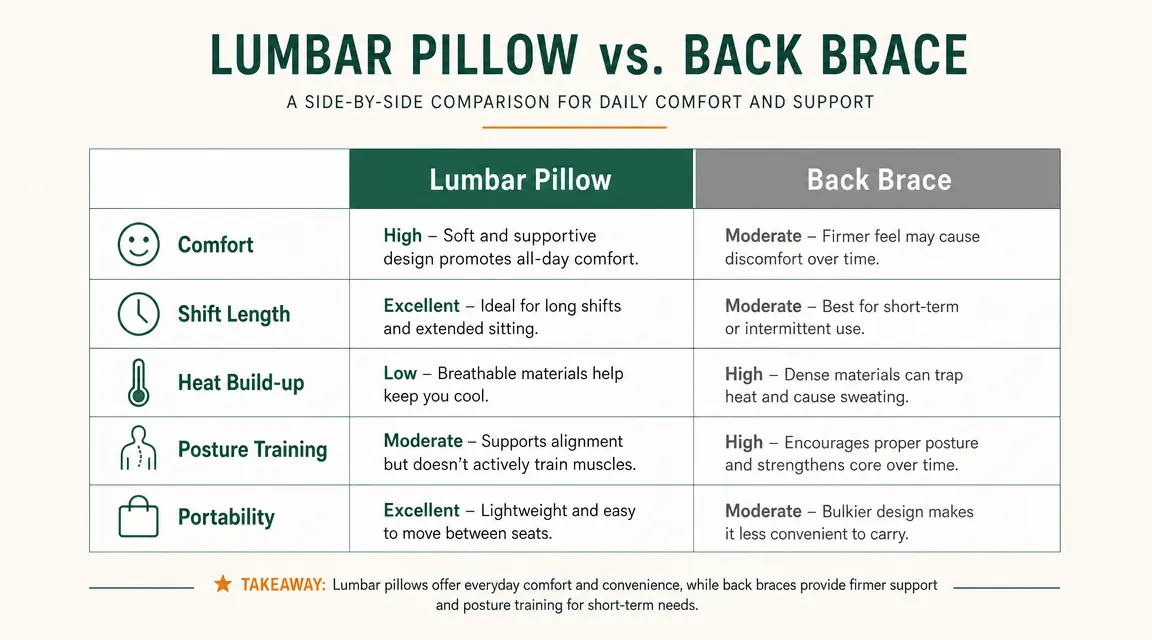
| Lumbar Support Pillow (QUTOOL) | Back Brace (Generic Lumbar Belt) | |
|---|---|---|
| Price range | Under $30 for a quality memory foam model | $25-$80 depending on brand and rigidity |
| How it works | Fills the natural lumbar curve so the spine sits in neutral instead of slumping into the seat | Wraps and compresses the core from outside, limiting flexion and reminding muscles to engage |
| Best for | Long continuous sits of 4+ hours in a fixed seat (cab, office chair, recliner after shift) | Short lifting tasks, dock work, or acute pain flare-up where restricted movement helps |
| Comfort over a full shift | High: memory foam breathes reasonably and does not compress your abdomen | Low to medium: rigid panels and tight closure dig in after 2-3 hours and build heat fast |
| Heat build-up | Minimal: pillow sits behind you, airflow around the waist is unaffected | High: neoprene or nylon construction against the core traps heat noticeably in summer months |
| Posture training over time | Yes: reminds the lumbar to maintain its natural curve passively through correct positioning | No: creates dependency; core muscles tend to switch off when the belt does the job |
| Moves with you | Stays with the seat, not with you. Adjustable straps hold it in place on most truck seats. | Worn on the body, so it goes with you from cab to dock to store |
| Downside | It is a seat tool, not a walking tool. Not ideal if you need to be on your feet for hours of dock work mid-run. | Long-term reliance can weaken the core and worsen the root problem. Not designed for multi-hour sitting. |
Where the Lumbar Pillow Wins
Sitting is the problem. When you drop into a driver seat, especially one that has a few years and 200,000 miles of compression behind it, the lumbar support built into that seat is basically gone. Your lower spine starts to round backward into a C-shape. After four hours, the discs in L3, L4, and L5 are loaded unevenly, the muscles along the spine are working overtime just to keep you upright, and you step out of the cab feeling ten years older than you are.
The QUTOOL pillow solves this at the source. The memory foam contour presses into the natural curve of your low back and holds it there, so your spine is not fighting gravity for hours on end. The dual adjustable straps loop around almost any seat back. I have had mine on an international cab, a rental box truck, and an office chair at the motel desk, and it does not shift around. The firmness is on the higher side of medium, which is what you want for all-day sitting. Soft pillows feel nice for twenty minutes and then flatten out to nothing.
The 4.4 stars across more than 26,000 reviews on Amazon tells you something. That is not a small sample of weekend warriors. That is a lot of people who sit for a living voting with their repeat purchases. I have seen drivers try cheaper foam options that compressed within a week. The QUTOOL has held its shape for me across consistent daily use, and that matters when you are relying on it every single day.
If you sit for a living, your seat is working against your spine. The QUTOOL stops that before it turns into a chiropractor bill.
Over 26,000 drivers and seated workers have rated the QUTOOL 4.4 out of 5. Memory foam, dual adjustable straps, and a contour designed for the lumbar curve. Check current pricing below.
Amazon Check Today's Price on Amazon →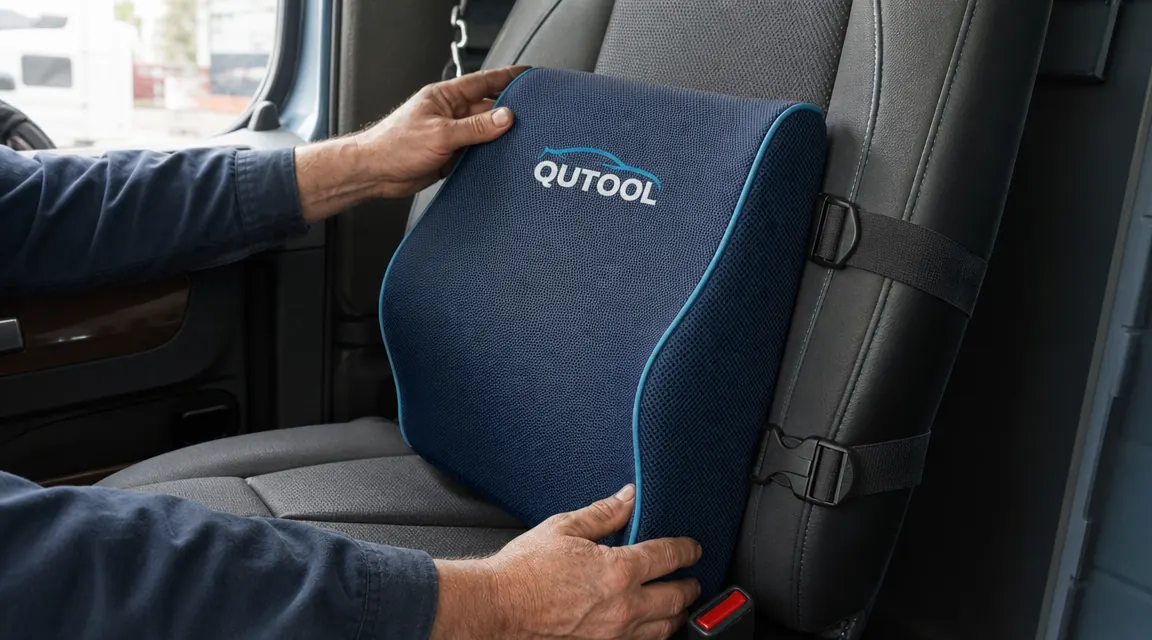
Where the Back Brace Wins
I am not here to trash back braces. They have a legitimate role, just not the one most people use them for. If you are doing dock work, unloading a van, running freight into a facility, or doing anything that puts you on your feet lifting and bending repeatedly, a back brace makes sense for that window. It restricts flexion and keeps you from rounding when you are fatigued. In that specific short-duration, high-repetition context, the compression and restriction are useful.
The problem is that most drivers reach for the brace before a long run and wear it for nine hours. That is where it goes wrong. The rigid panels were not engineered for long continuous sitting. They press into the soft tissue around the hips and waist, restrict breathing slightly, and build heat in a way that becomes distracting by mid-afternoon. Worse, every physical therapist I have ever spoken to says the same thing: wearing a back brace all day tells your core muscles that their job is covered. Over six to eight weeks, those muscles get weaker. When you take the brace off, the pain comes back worse than before.
I wore the back brace for three months straight on long hauls. When I finally took it off my back was worse, not better. The lumbar pillow is the one I actually kept.
Who Should Buy Which
If you are primarily a driver, meaning most of your work day is spent in a seat, the QUTOOL lumbar pillow is the right tool. You will get more relief with less heat, no core muscle dependency, and you can use it at home on the couch or at a desk without looking like you are at a construction site. It works in the cab, in the sleeper berth propped against the wall when you are watching your phone before bed, and at the airport or DMV when you are stuck in a waiting room chair that was designed by someone who has never sat in one for more than ten minutes.
If you split your day between long hauls and significant on-foot dock or warehouse work, consider keeping both. Use the lumbar pillow while you are in the cab and switch to the brace for the physical lifting portion only. The brace stays on for that one to two-hour window of physical work, not for the whole shift. That combination is what I have seen work best for drivers who do both.
If your back pain is acute, meaning you tweaked something in the last week or two and you are in real pain, the brace makes sense for short-term stabilization while it calms down. That is its lane. Once you are out of that acute window, move to the pillow for the daily maintenance of a healthy sitting posture.
How the QUTOOL Held Up Over Six Weeks of Daily Use
Week one: the memory foam felt slightly stiff. That is normal. It takes four or five days of heat and body weight to break in fully. Some people mistake that stiffness for it being too firm and return it early. Give it a week before you judge.
By week two, the lumbar curve placement felt natural rather than forced. I stopped being aware of it, which is exactly what you want. If you are constantly conscious of a support product, it is either in the wrong position or the wrong firmness. The dual straps let you fine-tune the height so the widest part of the pillow sits right at the belt-line, which is where the L4-L5 level lives for most adults.
By week six, the main change I noticed was that I was getting out of the cab without the usual first-five-minutes locked-up shuffle. The lower back was not spasming when I stood up after a four-hour stretch. That is the real test. Products that look good in photos and feel decent for the first hour but still leave you crippled at the rest stop are not doing the job.

What to Watch Out For With Both
With the lumbar pillow: strap placement matters. If the pillow rides too high, it pushes on the mid-back rather than the lumbar and can actually make things worse. Target the natural inward curve right above the belt line. If you feel pressure in the middle of your back rather than the lower back, slide it down two inches.
With the back brace: sizing is the most common mistake. Most people buy too large because they measure their waist at the belly rather than at the level of the iliac crest, which is where the brace actually sits. A brace that is too large slides around and does nothing. Also, do not wear it while you sleep. That instruction is in the manual and most people ignore it.
Neither tool replaces movement. Every 90 minutes you can, get out of the cab if circumstances allow. Even four minutes walking around a rest stop resets the compression loading on the lumbar discs. The pillow and the brace manage the problem between those breaks. They do not eliminate the need to move.
The Bottom Line
For a driver whose main time is spent in a seat, the QUTOOL lumbar pillow is the better daily tool. It is comfortable for a full shift, does not trap heat, does not create core dependency, and the quality holds up. More than 26,000 reviewers is not a fluke. The back brace earns its place for short-window physical work and acute injury recovery. Those are specific jobs. For the long sit, the pillow wins.
I keep both in my truck. But if I had to pick one and only one for the cab, the QUTOOL sits behind me every day. The brace lives in the door pocket for dock days. That is the honest short list.
Your spine is loading wrong every mile you drive without lumbar support. Fix the position first, then let the recovery take care of itself.
The QUTOOL memory foam lumbar pillow uses dual adjustable straps to stay put on any truck or car seat. Rated 4.4 out of 5 by over 26,000 buyers. Built for the kind of all-day sitting that destroys a back one hour at a time.
Amazon Check Today's Price on Amazon →