

Let me skip the honeymoon and start where most reviews end. I've had the QUTOOL lumbar support pillow on three different seats over the past four months: the captain's chair in a Class 8 cab, a folding chair at a loading dock office, and a worn-out recliner at home. Each one taught me something different about where this thing works and where it quietly drives you nuts. If you're reading this before you buy, that's the version of the review I wish I had found.
The QUTOOL Lumbar Support Pillow (ASIN B074C9F45S) is a memory foam back cushion with a dual adjustable strap system, a mesh cover, and a contoured shape designed to sit right at your lumbar curve. It has over 26,000 ratings on Amazon and a 4.4-star average. Numbers like that usually mean a product is genuinely decent, not just well-marketed. Here is what those ratings do not tell you.
The Quick Verdict
Solid lumbar relief for bucket seats and mid-back office chairs, with a real strap problem on wide vinyl semi seats and a two-week break-in period nobody warns you about.
Amazon Check Today's Price →Your lower back already knows it needs this. The question is whether it fits your seat.
The QUTOOL lumbar pillow is available on Amazon with free returns. If the strap system works for your seat, it is genuinely one of the better lumbar buys at this price point.
Amazon Check Today's Price on Amazon →How I've Used It
My name is Gary. I drove OTR for 22 years before I moved into a regional route about four years ago. I started testing the QUTOOL after a buddy on the same terminal picked it up and told me it cut his midday back ache in half. I ordered mine and put it straight into the cab on a Monday morning run to Nashville, about 9 hours round trip.
The first two days were a mixed bag. The foam felt noticeably stiff right out of the box, which is normal for memory foam but still surprising if you are not expecting it. By day five the foam had loosened up to the point where it actually conformed to my lumbar curve instead of just sitting flat against it. I also moved it around on the seat during those first two weeks more than I expected, which is how I figured out the strap issue.
After a month in the cab I moved it to the dock office chair for two weeks, then home for the last six weeks. All three settings taught me something different about what this pillow does well and where it falls short. That spread of use is the whole basis of this review.
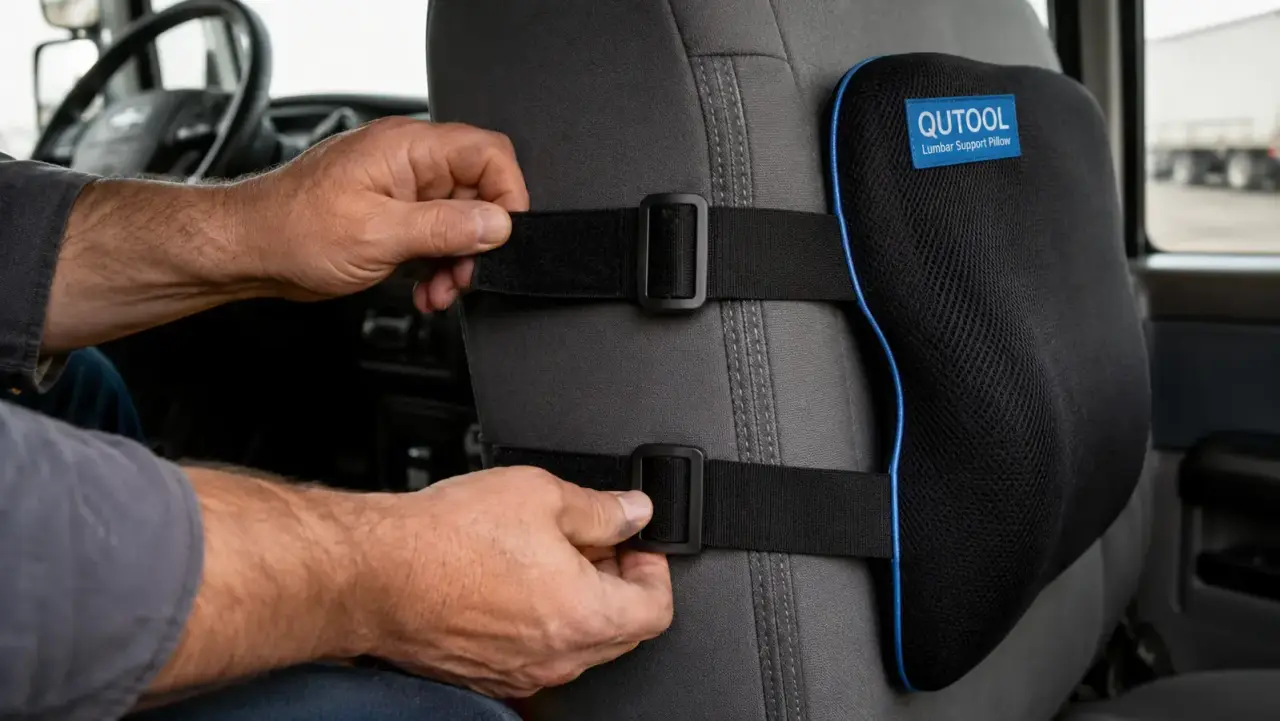
The Strap System: Where Half the Frustration Lives
The QUTOOL uses two adjustable velcro straps that loop around the back of your seat. On a standard office chair or a car seat with a narrow back post, they work fine. Cinch them snug, center the pillow on your lumbar, done. On a wide semi seat with a thick vinyl headrest and no easy grip point, the straps bottom out before they get tight enough to hold the pillow in place.
What actually happens on a wide cab seat is the straps sit loose, and every time you shift your weight or turn to check a mirror, the pillow rotates a few degrees or drops two inches. You stop noticing it for a while, then realize your lumbar support has migrated down to your tailbone. I spent the better part of the first week readjusting it every couple of hours. The fix I landed on was running a bungee cord behind the seat back to give the straps something to grab against. Not elegant, but it worked.
On bucket seats in a regular car or SUV and on most mesh office chairs, I never had the sliding issue. The seat backs are narrower and the straps have real purchase. If your primary seat is a car, a desk chair, or a standard delivery van seat, the strap system will not be a headache for you. If you drive a semi or a wide commercial vehicle, plan on a workaround.
The Break-In Period Nobody Mentions
I've heard from a few guys who ordered this, used it for three days, and sent it back because it felt too hard. That's a shame, because those guys quit before the pillow became what it's supposed to be. New memory foam at this density needs roughly ten to fourteen days of daily use before it softens to the point where it actually contours to your spine instead of just pushing back against it.
During days one through five, the QUTOOL will feel almost rigid. Your lower back may actually feel more fatigued, not less, because you're holding your posture against a firm surface rather than being cradled by it. This is the stage where a lot of returns happen. Stick with it past day ten and the foam transitions. It starts holding the shape of your lumbar curve between sessions. That's when the relief kicks in.
A quick tip: if you want to speed the break-in up, put the pillow flat on a hard floor, press down on it firmly for thirty seconds, and repeat a few times before your first use. Warms the foam and gets it moving faster. Not a trick the product page advertises, but it helps.

Firmness, Fit, and What It Actually Does for Lower Back Pain
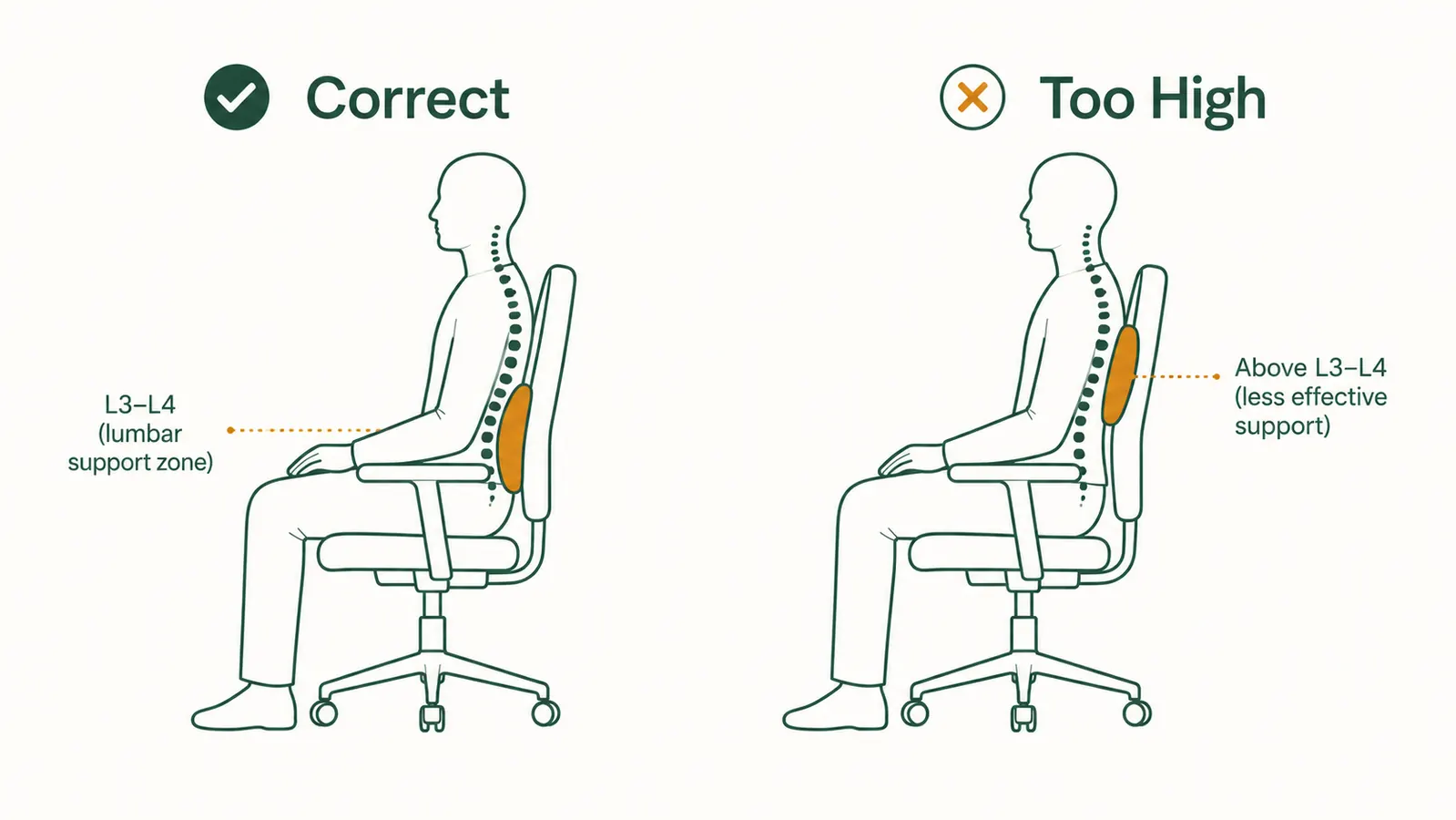
Once the foam breaks in, the QUTOOL delivers real lumbar support for the L3-through-L5 zone. That's the stretch of spine that takes the most punishment from prolonged sitting. The contoured shape follows the inward curve of the lower back rather than sitting flat like a rolled towel. That design choice matters because a flat surface pushes the spine straight and can actually increase disc pressure over time.
The width of the pillow is about right for most builds. I'm 6'1", 220 pounds, and it covers my lumbar zone without pressing into my hip bones on either side. My coworker Tony is 5'9" and stockier than me, and he found it slightly narrow for his lower back width. His read was that it sat dead center on his spine but left his flanks unsupported. That's not a deal-breaker, just a fit note for broader builds.
What I noticed after consistent use across long hauls was that my usual fatigue point moved. Before the pillow, I'd start feeling that dull compression ache around hour four. With the QUTOOL in place and positioned correctly, I was getting to hour six or seven before the same ache set in. That's not a cure. But buying yourself two extra hours of comfortable driving before you need to stop and stretch is meaningful when you're on a deadline.
The Mesh Cover and Heat Buildup
The mesh cover is removable and machine washable, which is a genuine selling point for anyone using this in a cab where you're sweating through the summer months. After three washes the mesh still looks clean and has not pilled or stretched. The zipper feels sturdy enough that I don't worry about it failing mid-haul.
Heat buildup is the one area where this pillow underperforms. After two hours of contact against your back in a warm cab, the foam retains body heat and the mesh stops breathing as efficiently. You'll feel a warm spot at your lower back. It's not uncomfortable enough to make you remove the pillow, but if you run hot or drive without AC in warmer months, it's worth knowing. A thin moisture-wicking undershirt helps more than you'd think.
After the break-in period, my usual back fatigue point moved from hour four to hour six or seven. That's not a cure. But two extra hours of comfortable driving before you need to stop and stretch is real, and it matters on a run with a tight clock.
Why People Return It: The Honest Short List
Based on the low-star reviews I read before buying, and on what I've heard from guys at the terminal, returns happen for four main reasons. First, people quit during the break-in period and call it too firm without giving the foam time to adapt. Second, semi and wide-seat drivers find the straps don't hold and get frustrated. Third, people with very tall seat backs find the straps can't reach around the seat and buy a pillow they can't mount at all. Fourth, people dealing with acute herniated disc pain or active sciatica flare-ups find that even a properly positioned lumbar pillow doesn't touch that level of pain. That's a medical situation, not a product failure, but the low-star reviews don't always make that distinction.
If none of those four scenarios describe you, the return risk is low. If you're in a semi or a wide-back commercial seat, know going in that you'll probably need a strap workaround. It's a solvable problem, but it's a real one.
What I Liked
- Memory foam breaks in well after 10-14 days and genuinely conforms to the lumbar curve
- Works well on standard office chairs, car seats, and narrow-back van seats without modification
- Mesh cover is removable, washable, and holds up through repeated laundering
- Contoured shape targets L3-L5 zone rather than pushing the whole back straight
- Over 26,000 Amazon reviews with a 4.4 rating means the quality is consistent, not a one-off batch
- Affordable enough that the break-in gamble is low financial risk
Where It Falls Short
- Straps do not hold reliably on wide vinyl semi seats without a DIY workaround
- Break-in period of 10-14 days catches people off guard and drives premature returns
- Heat buildup against the lower back after 2-plus hours of contact in warm conditions
- Slightly narrow for broader builds; flanks may feel unsupported on a wider lower back
- Does nothing for acute disc herniation or active sciatica flare-ups. Those need clinical care, not a foam pillow.

How It Compares to Using Nothing
The alternative most drivers use is nothing, or a rolled-up jacket stuffed behind the lower back. I did the jacket trick for years. The problem with improvised solutions is that they shift constantly and you're always half-aware of readjusting. That constant low-level distraction adds up over a 9-hour day. The QUTOOL, once properly positioned, stays where you put it on seats where the straps work and lets you forget about your lower back for several hours at a time. That mental relief is almost as valuable as the physical support.
If you want a more detailed look at how the QUTOOL performs over a full six-month span on a consistent long-haul route, read our companion piece: QUTOOL Lumbar Support Pillow Review: Six Months Behind the Wheel. That review covers what changes after the foam fully settles and how the strap hardware holds up over time. For a direct comparison with a traditional back brace, see Lumbar Support Pillow vs Back Brace for Truck Drivers, which lays out the tradeoffs for both approaches side by side.
Who This Is For
You are the right buyer for this pillow if you spend four or more hours a day in a seat with a reasonably narrow back, your lower back ache is the slow-build posture-fatigue kind rather than sharp disc pain, and you are patient enough to give the foam two weeks before you judge it. Car drivers, rideshare drivers, delivery van drivers, office workers, nurses who sit for charting, and machine operators in standard seats will all get real value from this. Buy it, put it in your seat Monday morning, plan to give it until the following Monday before you form an opinion, and you will very likely be glad you kept it.
Who Should Skip It
Skip this pillow if you drive a semi or a wide commercial vehicle and aren't willing to rig a strap solution. The frustration of a pillow that migrates every hour will outweigh the benefit. Also skip it if you are dealing with active disc herniation, acute sciatica, or radiating leg pain. That level of pain needs a physio or chiropractor, not a foam insert. And if you run very hot and drive without climate control through summer, the heat buildup will probably outweigh the back relief after a few weeks. In those cases, look at a harder contoured back support with ventilation channels, or compare the pillow option against a lumbar back brace, which stays put regardless of seat shape.
If your seat fits, your lower back will feel the difference within two weeks.
The QUTOOL lumbar support pillow ships with free returns on Amazon, so if the strap system does not work for your seat, sending it back costs you nothing. For most car seats, delivery van seats, and office chairs, it fits without modification.
Amazon Check Today's Price on Amazon →